• Letting Go…

    I feel like each new year, I set a theme, or perhaps some goals and resolutions, but by February, it’s back to the mantra – new year, same me. Or as Taylor Swift might say, “It’s me. Hi. I’m the problem, it’s me.” The lone common thread in all of these past failed attempts is yours truly.

    But I’ve been thinking about a question I saw recently whilst scrolling social media: “What do you want to let go of in the new year” and this struck me as a much more productive way to think about closing out 2025 and welcoming 2026. I suppose for some folks this might be a bit of a mind-bender. But the resounding response to the question, direct from my subconscious was stress.

    Stress and worry. The antithesis of silver and gold. Or leather and lace for that matter. But the point is the same. These evil twins have haunted me for the better part of my life to the point where I’m not entirely sure what a stress-free, worry-free existence would look like.

    The problem stems from triggers. There are so many of them. Whether its stress or worry, they can all at various times utterly debilitate me.

    So, there seems some wisdom in thinking about the opposite of those triggers. This led me to try and recall the most peaceful day I can remember.

    And I remember it well.

    I was a sophomore at Dartmouth. We were pressing toward the end of Spring term and finals had just wrapped up. Class had not yet begun, and Sophomore Summer was on deck (this is where the rest of the campus goes away except for the sophomore class who take a couple of classes and generally enjoy the New England summer from the comfort of alma mater). So, after a jaunt to church in Woodstock, VT, I made my way back to campus and stopped off near the Quechee, VT dam. I meandered away from the little shops along the town’s main drag and found a perfectly-manicured, expansive, green lawn near the river.

    And I did something I seldom do. I laid down. Right in the middle of the park. The sun warmed my face. A late spring breeze rustled my hair and I remember thinking to myself, in that moment, all was right with the world. And it was. I was a young man. No money. No debt. No expectations. Just a full belly after church and the promise of an entire summer ahead.

    I’ve often thought about this day as being one of the ‘good ole days.’ A better time than the present. In most respects that day fit the bill. But I didn’t recognize it like this at the time.

    The four, halcyon years of college were some of the best I had. And yet, even in the midst of them all, I had yearnings for a future time. For better things and better times.

    The lesson I take from this and the social media question posed is simply that the good ole days are really now. Not some distant future point that may or may not come. Not some future when all of the hard work pays off, and the debt is gone and life is where we think we want it to be. It’s really, just, today.

    I think the rub is to recognize each day for what it is. To free the mind from worry. And memento mori. No future interests are guaranteed.

    So, I’m not sure how, but my goal among others is to let go of those evil twins, stress and worry. They haven’t been terribly helpful anyway.

  • The Last Duck on the Pond

    It was a chilly morning, about 19 degrees, when I did my walk. I had to wear a coat and a stocking cap. But it’s a walk I’ve taken many times and in much colder, more inclement weather. In order to take the air, I usually walk from the nearby gas station – which serves a superb breakfast sandwich – back to the house here in the neighborhood.

    On my walks, I typically encounter a number of furry and feathered friends. I’ve said hello to the occasional bald eagle. To chonky prairie dogs who scream at one another to herald my arrival. And to flocks of geese headed south for the winter. I’ve even seen the odd raft of ducks, swimming in the artificial pond, keeping their heads low to steer clear of the geese.

    On this cold morning, there were no geese, and only the fattest of prairie dogs were scurrying about. I saw a couple of intrepid joggers of the human variety. But, in all, the faded morning sun and the arctic blast seemed to keep most folks indoors. It was strange being one of the few people out and about when there is normally so much life bustling all around. And especially strange given that I would typically rather be in a warm bed on a cold morning than out for a walk. But fate sometimes has strange trips in store for us.

    After scarfing down my breakfast sandwich, I made my walk home against a brisk wind. I went to college in New Hampshire and did a post-doc in Wyoming, so the cold is something I feel somewhat accustomed to. But this seemed to be the type of cold that numbs the bones and then the soul, in short order. I could feel my teeth chattering. I’m not entirely sure if I still had hands. But it was, nevertheless, eminently the type of walk that was well-suited for reflection. Naturally, some life disappointments had been playing in my mind and I was a bit lost in my thoughts.

    I didn’t even realize that I had ambled up alongside the water. It was only when I chanced to look up that I noticed the last duck on the pond. He didn’t seem especially concerned about being alone. Rather, he seemed to accept his lot: a lone drake swimming out from the reeds. I didn’t see a hen nearby but she could have been tucked away. Regardless, he seemed content and paddled out toward the center of the pond.

    He gave no look toward me. To him, I could well have been one of the joggers I passed earlier and gave no heed. Yet he paddled on, seemingly impervious or oblivious to the cold. It was a bit disconcerting to watch him, hell bent on whatever mission he was on in perfect ignorance of whatever was going on in the human world around him.

    I found his situation envious.

    One problem of modernity is that we humans tend to care about too much. I mentioned in my last post that we worry about the past, present, and future. And then we worry about every conceivable permutation associated with each. With each permutation, we invite an inordinate amount of stress into our lives that we are neither able to mitigate, nor address. It all makes for a rather unfortunate state of affairs. But what I learned from my indifferent, feathered friend is that sometimes simply accepting the state of things as they are is as fine a conclusion as any.

    After a quick snap, I walked on home and took stock of my worries. Many of them were not things that I could sort out at the time. Many of them were not things that I have sorted out since. But the picture above reminds me that, on occasion, the best course is merely to accept the circumstances and paddle on.

  • Thoughts from Colorado

    It’s a drop past 10:30 AM here in Colorado. I really do like this state. For all of the shenanigans going on in the Country and the World, the Rocky Mountains look on at the folly of man with muted bemusement.

    And that’s as it should be. We humans have much foolishness to commend to them on our own behalf. And yet, in this place, the day carries on, unimpeded by the ebbs and flows of time.

    Today on my walk, the Prairie Dogs heralded my arrival and departure. They’re certainly plumping up for the throes of winter still to come.

    Today also brought on a new group of buddies on my walk. A flock of Canadian Geese stopped by as they headed south for the winter. They sat placidly on the cold artificial pond here in the neighborhood. A gaggle of nonplussed creatures if ever there were.

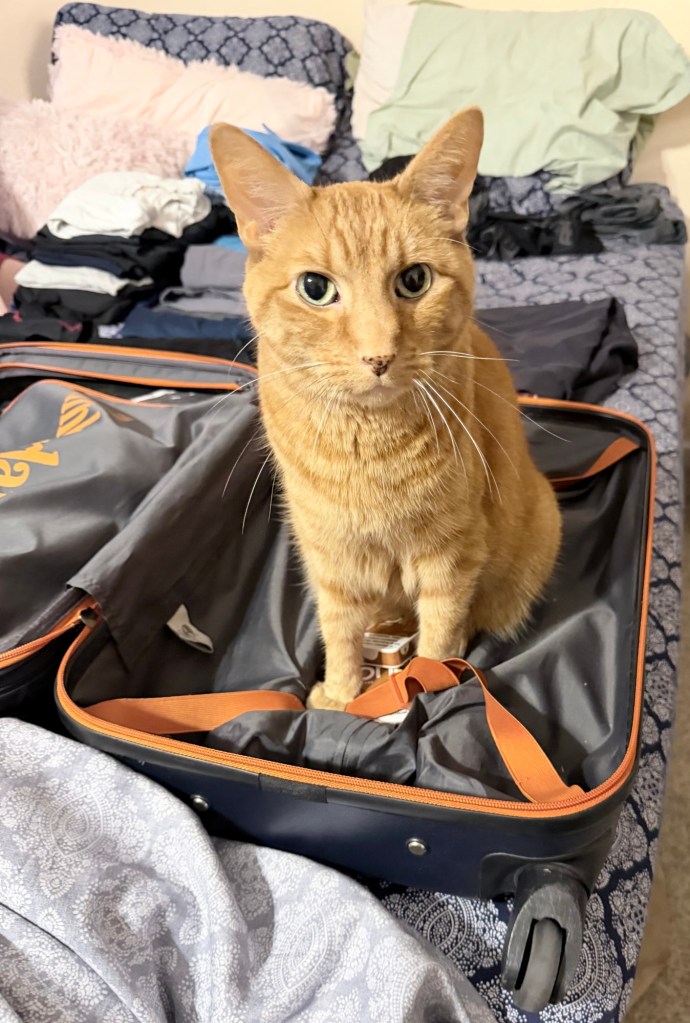
    Even Kitty sits by the window taking in the faint sunlight of a cloudy, early-winter’s day.

    From the animals, we see life is so simple. Yet, we humans have a knack for making things complicated.

    We fret and beat ourselves up over all three phases of time: We worry about our pasts and lost opportunities that we can do nothing to affect; we worry about our present and the extent to which what we do today will impact our tomorrow; and we worry about tomorrow and what fresh hell it might bring. And for what? Whither our worries?

    I can’t in good conscience say that worrying about anything has ever made life easier.

    But I think that even on this score we are overly harsh with ourselves. It’s true that worry is superfluous. But worry means that we care. Somewhere, deep in the heart, we worry because we do care about outcomes. We care for our present and future, those we love, and even about our actions in those moments of time that have already passed.

    And the reality is, I’d much rather worry and care than feel nothing at all.

  • The Problem of Time

    I’ve been thinking a lot about time lately. For all of my travels and nomadic lifestyle, more often than not, I wonder whether I’ve placed myself in the position of NOT showing up and being present for those I love and care about.

    I live in Oklahoma. My son lives in Indiana. My family lives in Oklahoma. My girlfriend lives in Colorado. And my place of employment is based in Arizona- though much of my erstwhile work was mostly national and international in scope. Suffice it to say, it’s a lot to juggle and I live out of suitcases and backpacks more often than I’d like. A part of me longs for a place to call home.

    Like many of you, I’ve done this for nearly a decade.

    I heard a hymn long ago with a verse that says, “Time is now fleeting the moments are passing. Passing for you and for me.” That’s true. Every moment not spent in one place is spent in another. And once you string together enough moments, time passes by.

    Time these days seems less about travel and more about presence.

    In my life, I’ve often felt that life was such a hurry. A hurry to achieve – whether it be financial, career, or educational success. But I am learning, slowly, that the rush causes one to miss out on the things that are actually worth enjoying. As an old country music song put it, “I rush and rush until life’s no fun…but I’m in a hurry and don’t know why.”

    And I wonder, what would be the harm in slowing down? To savor moments. To enjoy the journey as the Zen among us might suggest. Yet, this seems to be, among many things, one of the things I can’t seem to do. Rushing is second nature. On to the next thing, no matter how much I might try to savor the moment. At any given point, there are a million other moments competing for my attention, and I can’t for the life of me sort out why.

    The reality is that none of my rushing matters. Clarity will come. Resolution will come. Satisfaction will come. Things will sort themselves out one way or another. All I can do is keep moving and wait.

    The problem of time is that it moves so slowly when one would that it were fast. And it moves so quickly when one would that it were slow. If I were to rely upon the caprice of time, the result would be a perpetual state of malcontent – which, the years have taught me, is no way to live.

    In this season of life, I feel that the best way to navigate the past and the road ahead is to slow down. I’ve rushed for so long and ventured so far from my moorings that it’s actually quite useful to take stock and see where my values lie.

    The reality is that we don’t get a “do-over” in the life. It’s only one shot. And we have to make it count.

  • The Last Egg

    I’ve spent the past couple of weeks after my son’s birthday here in Indiana. We carry on with our routine as we always have. I wake him up. Sort his clothes. Make sure he gets on the bus. In the meantime, I cook him an egg.

    The routine went okay this morning. He seemed a bit churlish. I think he had some issues falling asleep last night. But we did the things – he got dressed, I cooked the egg and he got on the bus fine. I do not know if this is the last breakfast I’ll cook him while I’m here. But it leaves me a bit wistful.

    As he sat down to eat, it occurred to me that, someday, there will be a last egg. His preferences, like his body will grow and change. What is preferred today will no longer be preferred tomorrow. And then I will no longer be needed to cook the egg anymore. Nor will it be wanted. Another vestige of youth lost to anachronism.

    That’s fine really. I don’t recall my last breakfast with my late grandfather. I just remember what a joy it was to have had them. And I think that’s the point of memory and of time. Not that I do the egg, but that I love him and showed up. Perhaps, if I’m lucky, through some miracle of memory, when he’s older he’ll remember that Dad came to Indiana sometimes and cooked the egg. I hope he remembers then how much I love him.

    I will leave here on Sunday. Duty calls back home and points west. But a piece of my heart always stays here with him – as it should.

    But man, I hope that last egg doesn’t come too soon.